configuration

PO numbers by Ship-To location in your Free Purchase Order Software

Jody is using the free version of SpendMap to manage spending for a chain of bar/restaurants, and was wondering if there is a way to set up a separate sequence of PO numbers for each Ship-To location.

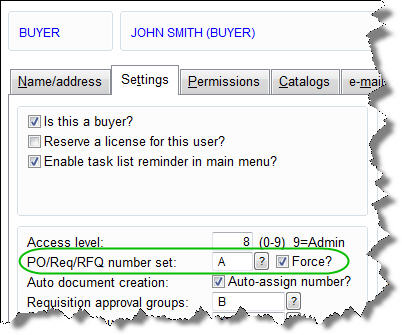
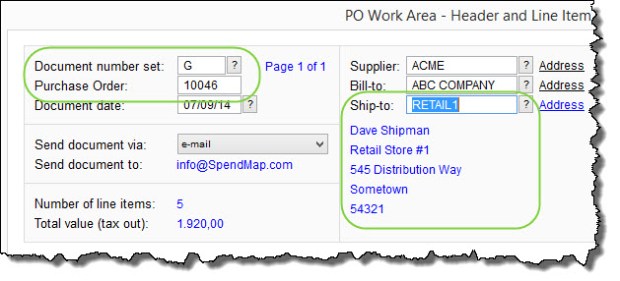
While there is no “direct” link between Ship-To locations and PO Number Sets, you can set up an indirect relationship by way of the user accounts.  That is, in the User Master File, you can 1) set up a default Ship-To for each user, and separately 2) assign each user a default PO Number Set.

If you do both those things for all users at a location, and assuming they don’t change the defaults when entering POs (and/or if you lock out those fields so that they cannot change from the defaults), then all POs for each Ship-To will also be for that PO Number Set…
PO-BY-SHIP-TO

Again, this is not a “hard relationship” (i.e. rule) in the software per se, it is simply one way to configure it.  That said, it seems to work well for most people who ask about this.

You can set up your Ship-To locations in here…
– PURCHASING > Master Files > Cost Centers > Add/Modify/Delete

You can set up your PO Number Sets in here…
– PURCHASING > Setup system > Incrementing document number sets > POs

You can specify the default Ship-To and PO Number Set for each user in the [Settings] Folder of the User Master File, in here…
– PURCHASING > User setup > Add/modify/delete users

And, if you want to, you can lock/restrict access to the PO Number Set field and/or the Ship-To field in the PO Work Area (so that users can’t change from their defaults), using this…
– PURCHASING > User setup > Field restrictions by user access level > Set field restrictions

Using vs. Implementing your Free Purchase Order Software

needs-help

Brenda was struggling a bit with her implementation of the free version of SpendMap, so we helped her by providing free support when she had questions about setting up her Master Files, using the built-in integration tools, and otherwise configuring the system to her needs.

But she still had a concern…

I’m worried that if I’m having trouble, it will be impossible for our staff as they are not very computer savvy at all“.

Fair enough, but keep in mind that implementing a business application like this is more involved than just using it for your day-to-day work.  For example, entering a Purchase Order or Requisition in SpendMap is much easier than setting up the master files, going through system configuration, etc.

Our customers tell us all the time that their users can handle the “day-to-day” stuff, with no training at all!

And remember, with User Definable Menus, you can remove everything from your staff’s field of view that they don’t need, leaving only the few functions that they’ll use to do their daily tasks (e.g. Enter a PO or Requisition, check the status of their order, etc.).

But Brenda certainly has a valid point.  This type of system is definitely more involved to set up than, say, a simple word processor or something, that you can just install and start using.  There are configuration settings, workflow options, master files to populate, not to mention mapping the functionality to your business processes, which in and of itself can take some time.

All that said, keep in mind that there is definitely a big carrot to keep you motivated while you work get the system going.

On a separate but related note, we will soon be offering Getting Started training and implementation consulting packages for users of the free version (until now, these services were reserved for people using our paid version only).  Make sure to follow our Blog, where we’ll make the announcement when the Getting Started package is available.

Don’t give up folks.  Rome wasn’t build in a day.

Screen Resolution Settings and your Free Purchase Order Software

We’ve had a few support tickets from people who are using the free version of SpendMap on Microsoft’s new Surface Pro Tablets, with the setting “Make text and other items larger or smaller” set pretty high (e.g. 150%).

Settings like this can affect SpendMap’s minimum screen resolution test, resulting in an error message that you don’t have the required minimum 1024×768 screen size.

If you get this error message, try adjusting that setting to 125% (or until you stop getting the message).

TIP: The higher your screen resolution, the smaller SpendMap (and other software applications) will appear on your screen.  Instead of adjusting your computer’s overall screen settings, you might also consider adjusting the “Font/screen scaling factor” in SpendMap, using setting #10 in Workstation Configuration Settings (PURCHASING > Setup system > Workstation configuration settings).  This will make SpendMap appear bigger on your screen, without affecting other apps on your PC.

screen resolution

How rejected requisitions affect budgets in your free Purchase Order Software

David works at a government agency in Texas and was wondering why rejected requisitions still show as commitments to the cost center’s budget.

Based on the settings in the Requisitions and Approvals Module, rejected requisitions will stay in the budget temporarily because often the Requisitioner will modify and re-process the requisition (e.g. try again with a different item or otherwise clean up whatever the Approver didn’t like).  So SpendMap will keep the budget “reserved”, to avoid that part of the budget being picked up by someone else, and therefore reduce the chance that the original Requisitioner will be “out of budget” when they try again.

But if they don’t want to try again, they can either 1) delete/cancel the requisition, or 2) there is a setting to “auto-delete” rejected requisitions after a certain number of days, which will eliminate that additional step, or if the user just forgets to cancel the Requisition.  You can find that “auto-delete” setting in here…
– REQUISITIONS AND APPROVAL > Setup system > Miscellaneous settings

Reminder:  Users will see rejected requisitions the next time they go into their Requisition Work Area.  If you would like to be a bit more proactive, just enable this e-mail notification…

Rejected requisition email notification

Decimal places for price and quantity fields in your free PO System

By default, the Price and Quantity fields are set to two (2) decimal places in the Free Version of SpendMap (e.g. $123.12).

But when purchasing items with a very low unit price, you may need to increase the number of decimal places for prices, which you can do in here…
– PURCHASING > Setup system > User defined terminology and settings > User defined field settings

decimals in free PO system

You might also want to consider the unit of measure that you’re using.  For example, if you purchase by the thousand (M), you’d need fewer decimal places (e.g. $123.45 vs. $1.2345).  You can set up your units of measure in here…
– PURCHASING > Master Files > Units of measure > Add/modify/delete

Multiple PO number sequences in your free Purchase Order Software

Lisa works in the construction industry in South Africa and was asking about setting up different sequences of PO numbers for each of her projects…

“We work on a lot of different sites and we need different sequences of (Purchase Order) numbers for each project/job – how do I configure the different sequences?”

Sure thing Lisa, you can set up a different “PO Number Set” for each Project/Job, each with its own incrementing PO number.  Then you can select that Number Set when creating orders for that project.  Here’s the menu option…
– PURCHASING > Setup system > Incrementing document number sets > POs

If you like, you can also assign a default PO Number Set to each user (e.g. if a user works on specific Project), so that it defaults to their PO Number Set automatically for each new order.  You can optionally do that using the field called “PO/Req/RFQ number set”, in the [SETTINGS] Folder of the User Master File.

If you don’t specify a default for a user (e.g. if they work on multiple projects/jobs), they can just select a PO Number Set when creating each new Purchase Order in their PO work Area.

Finally, if you want a user to have access to ONLY one Number Set and no others, you can use the “Force?” check-box, just to the right of the “PO/Req/RFQ number set” field…

PO Number Settings for User

Entering PO numbers manually in your free Purchase Order Software

Marsha works at a shipyard in Newfoundland, Canada, and was asking if she can enter her PO numbers manually, instead of SpendMap assigning the next Purchase Order number automatically for each new order.

Sure thing Marsha, you can enter your PO numbers manually on each new PO if you prefer.

The Setup Wizard, which runs automatically when you first run the Live Copy of SpendMap, will set up an “auto incrementing” sequence of PO numbers, since most people want that, but you can either;

  1. replace that auto-incrementing number with the option of manually entering your PO numbers, or
  2. you can set up multiple “PO Number Sets”, and one of the Number Sets can give you the next sequential number for each new PO, and you can use a separate PO Number Set that allows you to enter the PO numbers manually for certain orders when you need to.

You can change the settings in here…
– PURCHASING > Setup system > Incrementing document number sets > POs

If you want to enter your PO number manually, just enter “.” (a period, without the quotes) in the Next Number field, then select the check-box to “Allow user to modify number”.

PO number settings